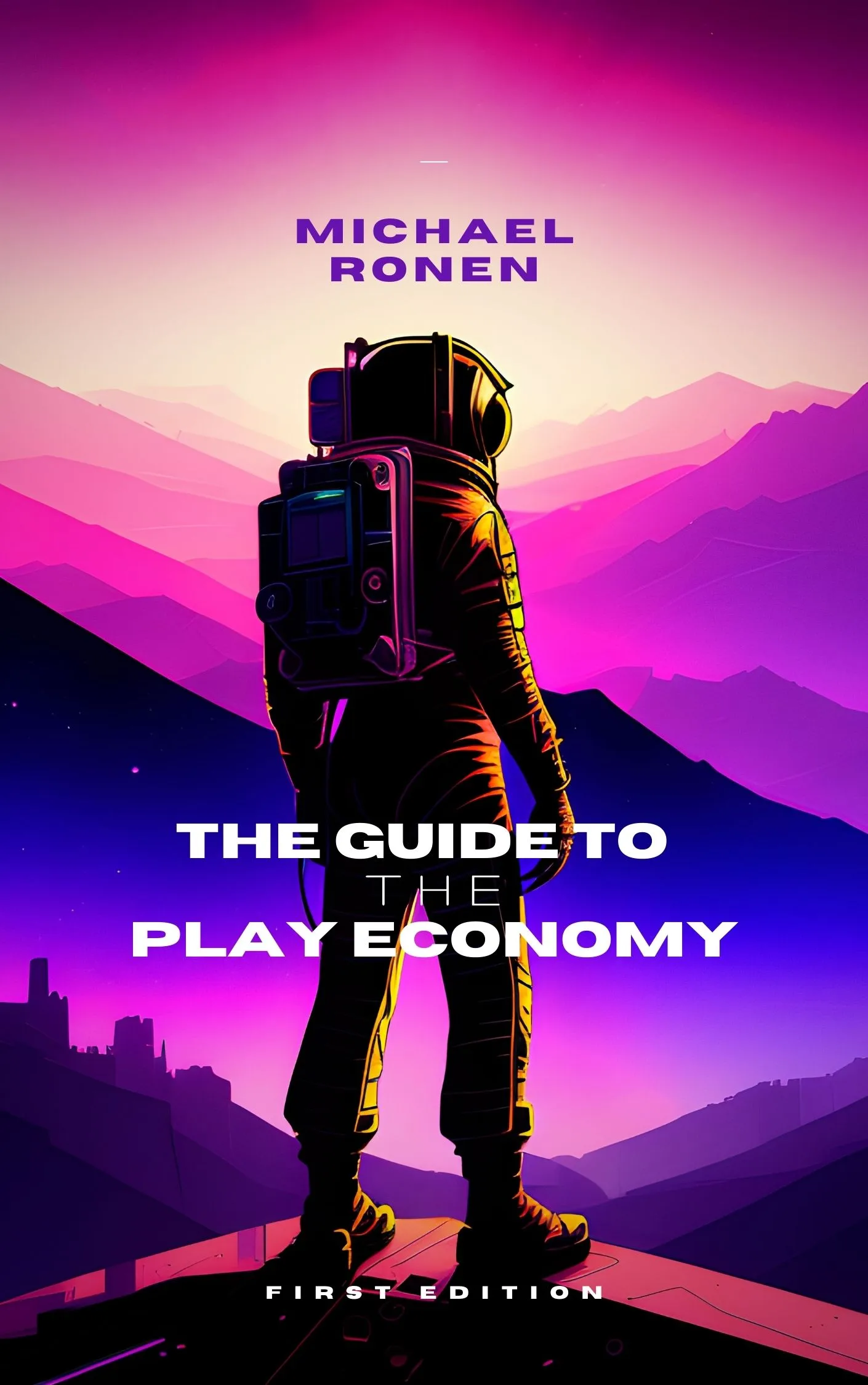
A Book by Michael Ronen · 2024

Play is not a
pastime.
It's the future
of everything.

The Play Economy is a new economic paradigm where the boundaries between work, play, and everyday life blur into integrated experiences. This is your entry point.

Get the Guide — Free Explore the Framework →

29+

Chapters

5

Framework Phases

17+

Industries Covered

Possibilities

Empathize
Define
Ideate
Prototype
Play-Test
XR & AI
Co-Creation
Phygital
Homo Ludens
The Play Economy
Empathize
Define
Ideate
Prototype
Play-Test
XR & AI
Co-Creation
Phygital
Homo Ludens
The Play Economy
"Play itself is the underlying enabler of
connection, creativity, and meaning."
— Michael Ronen, The Guide to the Play Economy
Economic History

Six Stages.
One Destination.

The Play Economy is the next stage in economic evolution — not a trend, but a paradigm shift centuries in the making.

01
Agrarian
Food production and bartering
02
Industrial
Mass production in factories
03
Service
Expertise and support services
04
Information
Digital technology and data
05
Experience
Memorable, engaging events
06 — NOW
Play Economy
Immersive co-creation with XR and AI, blending physical and virtual
The Framework

Five Phases.
One Playful Process.

The Play Economy Framework guides individuals and organizations through a creative process that transforms challenges into opportunities through empathy, experimentation, and iteration.

Phase 01
Empathize
Understanding Through Play
Phase 02
Define
Core Problems & Opportunities
Phase 03
Ideate
Play-Based Solutions
Phase 04
Prototype
Role-Play & Simulation
Phase 05
Play-Test
Iterate & Refine
01

Empathize

Understanding Through Play

Cultivate empathy by stepping into the roles of customers, team members, or other stakeholders through immersive experiences. Use play to unlock perspectives that data alone can never reveal.

Facilitate role-playing sessions where participants embody different personas — customers, employees, stakeholders
Use AI and XR technologies to simulate real-world scenarios customers experience
Map customer journeys as hero narratives to better understand emotional pain points
02

Define

Core Problems & Opportunities

Once empathy is built, synthesize your insights and define the key problems or opportunities with precision. This is where play-derived intuition meets strategic clarity.

Analyze data gathered during role-play to pinpoint specific pain points and challenges
Use customer journey maps to identify friction points and areas for improvement
Lead group brainstorming to frame core challenges as actionable opportunity statements
03

Ideate

Generate Play-Based Solutions

Centered on creative idea generation through play and gamification. Suspend disbelief. Discard conventional constraints. The best ideas emerge when the rules of the game change.

Engage in suspension-of-disbelief exercises where participants imagine solutions without usual constraints
Apply gamification methods to reward innovative ideas and create a collaborative atmosphere
Use AI-driven tools to generate and combine different ideas based on group input
04

Prototype

Role-Play & Simulation Models

Develop prototypes based on the ideas generated, testing them in low-stakes environments. Act out, simulate, build — fail fast and cheaply so that you succeed when it matters.

Develop quick, low-fidelity prototypes using AI-powered simulations or XR environments
Conduct role-play sessions where participants act out the proposed solutions
Create multiple iterations and test them across different scenarios
05

Play-Test

Iterate & Refine Through Play

Test prototypes in real-world or simulated environments. Gather feedback. Refine. Repeat. The Play Economy rewards those who iterate with joy, not fear.

Host play-test sessions where customers or stakeholders interact with the prototypes
Use AI-driven analytics to gather data on user interactions and feedback
Run iterative cycles of testing, feedback, and refinement to improve solutions
From the Book

Words That
Change the Game.

01 / 12
On the Paradigm
"The Play Economy represents a new emerging economic paradigm fueled by technological advances, where the boundaries between work, play, and everyday life blur into integrated experiences."
03 / 12
On Technology
"In the world of AI, Web3, and XR, development is guided by human values. It's about creating technology that not only impresses but also resonates with and empowers the human experience."
04 / 12
On Participation
"The Play Economy transforms passive spectators into active participants by giving users greater control, input, and influence over the experience."
05 / 12
On Empathy
"Play becomes more than fun; it's a tool for empathy and learning. Role-playing, especially, offers transformative insights, turning training sessions into adventures and fostering understanding across cultures."
07 / 12
On Flourishing
"The Play Economy leverages digital abundance to maximum potential for human flourishing. It promises collaborative, interactive futures facilitated by technology but centered on the innate human desire to play, explore, connect, and create."
08 / 12
On the Physical World
"The Play Economy should augment the physical world, not replace it."
09 / 12
On the New Models
"The Play Economy is characterized by playful branding, hybrid virtual events, phygital products, gamified interfaces, personalized experiences, and playable ads."
11 / 12
On the Hybrid World
"Virtual and augmented reality merge with physical spaces to create blended 'phygital' experiences — from digital fashion items to mixed reality educational quests."
12 / 12
On What's Ahead
"The future is playful. Are you ready?"
Inside the Book

29 Chapters.
Every Corner of the Play Economy.

From foundations to sector implications, from emerging technologies to governance and society — a complete map of the playful future.

Part I — Foundations
Ch. 1–4
What Is the Play Economy?
The core paradigm, its foundations, the Five Phases framework, and play's unexpected history from prehistory to today.
Part II — By Sector
Ch. 5–16
Implications Across Industries
Play at work, the careers of the future, commerce, healthcare, wellness, marketing, entertainment, education, activism, real estate, and travel.
Part III — Technologies
Ch. 17–20
The Tech Powering Play
XR's reality revolution, AI's creative unleashing, blockchain's ownership redefinition, and how smart objects are coming alive.
Part IV — Strategy
Ch. 21–24
Playbook for Organizations
How to thrive in the Play Economy, level up your lifestyle, harness the power of play communities, and overcome the pitfalls.
Part V — Society
Ch. 25–29
Governance & the Future
The future of play and communication, participatory policymaking, co-creating the future, sustainable development, and a playful conclusion.
Highlight Chapter
Ch. 6
Dream Jobs of the Future
The coolest careers ahead — from immersive experience designers to AI play architects. The jobs that don't exist yet, but will.
"Play is not compartmentalized but
a holistic part of the human experience."
— Michael Ronen, The Guide to the Play Economy
The Author

Michael Ronen

"I realized the tools themselves were not the real source of magic. What mattered most was our human imagination and the ancient power of play."
— Michael Ronen, Introduction
Immersive Director Tech Founder Author XR / AI Wonderland Immersive SXSW Winner
2007
Directed "Kavahane — Turkish Delight German Fright," a site-specific immersive performance in Berlin that launched his journey into participatory design
2012
Delved into location-based media, sharing stories through physical spaces
2015
Splash, his SXSW-winning VR app, allowed people to capture and share peripheral views
Now
Founder of Wonderland Immersive Design, pioneering Web3, Metaverse, and XR experiences — and author of The Guide to the Play Economy

Michael Ronen is an immersive director, serial founder, and the conceptual architect of the Play Economy. Born in Israel, his career has spanned theater, technology, and everything at the intersection of the two.

His formative years creating immersive theater that tackled political and human narratives taught him the power of radical empathy and shared visions. Even as he navigated through digital media and emerging technologies like AI and the metaverse, the essence of human imagination and play remained his north star.

"I came to believe creativity should not isolate us, but weave us together," he writes. That conviction is the foundation of the Play Economy — a framework not just for business, but for how we choose to live.

Through Wonderland Immersive Design, Michael has worked with innovative entrepreneurs to create products that embody Play Economy principles — from the FutureSelf AI meditation app to gamified real estate investment platforms.

The Guide to the Play Economy is his invitation to you: step out of the audience and onto the stage of the emerging economy.

wonderlandimmersivedesign.com ↗ Read the Guide
Free Access

Enter the
Play Economy.

Get the full guide free. No paywall, no catch — just Michael's complete framework for navigating the future of work, play, and everything in between.

No spam. Unsubscribe whenever. Your email stays with Michael, full stop.

You're in. Check your inbox — the guide is on its way.

Welcome to the Play Economy.

Full 29-Chapter Guide
The complete exploration of the Play Economy paradigm, from foundations to the future
The 5-Phase Framework
A practical, runnable workshop framework for any organization or individual
Sector Playbooks
Deep dives across 17+ industries — from healthcare to activism to real estate